
You’ve built something aggressive on purpose.
Capital moving, positions you understand well enough to explain in one sentence, a plan that doesn’t apologize for wanting more. And somewhere in your feed right now, a confident voice is telling you that the floor underneath that plan is actually what’s holding it back.
A real operator wouldn’t tie up capital in something so slow, the whole point of being this far along is to stop playing it safe.
Here’s the problem with that argument. It’s answering the wrong question. A plan with no floor isn’t more aggressive. It’s undefended.
The real fight was never guarantee versus growth. It’s whether the two are sequenced, and that answer turns out to be a number, not an opinion.

Both Sides Are Telling You Something True
You’ve probably run into this argument from two directions by now, and they don’t agree with each other, which is exactly why it’s worth resolving instead of picking a side.
One side says the floor is a trap: a return too good to be true, sold to people who should be demanding more from their capital. Fisher Investments is running one of the more aggressive ad campaigns in this space as I write these words, most of it dynamic creative hammering a single line, that guaranteed income and protection from market downturns sounds too good to be true.
They’re not wrong, if that’s the whole pitch. A guarantee sold as your entire financial plan, no growth, no upside, no engine for building anything, probably is too good to be true, because it’s a partial claim only.
The other side says that same mechanism is the whole play: take direct control of your own capital, stop routing it through a bank. Chris Naugle just came off a quiet stretch and resumed active spend, for example.
Doug Andrew has held steady at his high-water mark, because the pitch still works on its own: banks use your money to make money, so why shouldn’t you?
They’re onto something too. A private capital base you actually control is a real asset, not a consolation prize. Building a foundation you can borrow against, on your own terms, without asking a bank’s permission, is a legitimate move.
The instinct isn’t wrong. But here’s where both arguments stop, in opposite directions. Fisher stops at “the guarantee is inadequate” and never says what a properly sized allocation to it does for the rest of your balance sheet.
Naugle and Doug Andrew stop at the mechanism itself and never say what percentage of you it’s supposed to be, or what the rest of your capital is now free to do because it exists.
Neither pitch is lying. Both are incomplete, and incomplete in the same specific way: they’re treating the floor and the growth as if they compete for the same dollar, so more of one is definitionally less of the other.
That shared premise is the actual problem. Neither competitor’s product is.
The Hierarchy of Wealth™ Answers This With a Number, Not an Argument
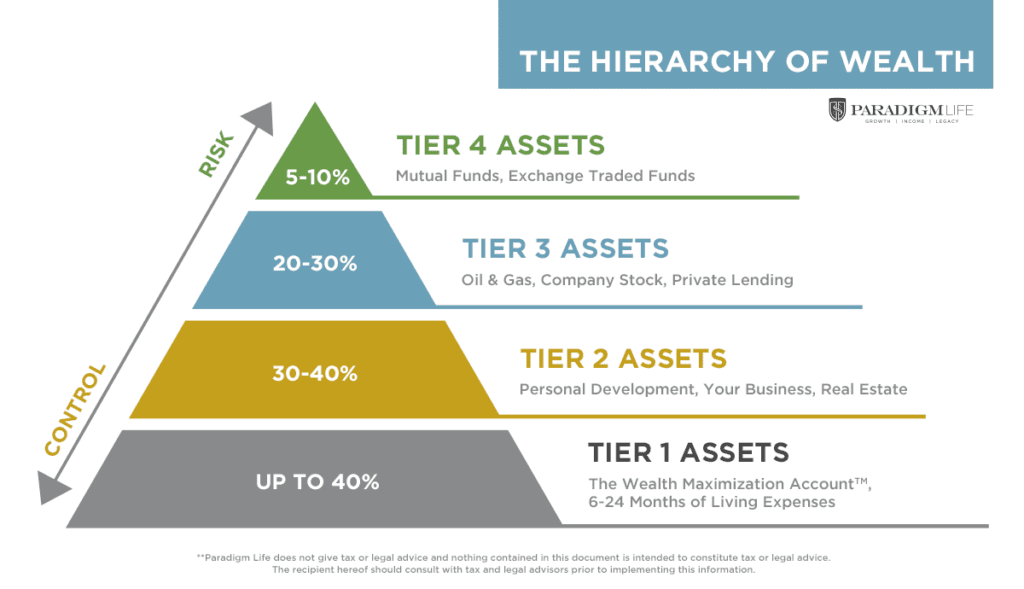
The Hierarchy of Wealth™ is the model behind how a well-organized balance sheet gets structured, across four tiers ordered by control and risk, not by return.
Tier 1, the Foundation tier, runs 30 to 40 percent of net worth: contractual guarantees, principal protection, cash value that grows by contract instead of by hope, currently targeting a 3 to 5 percent net return.
Tier 4, the far end, is Asymmetric and Speculative, 5 to 10 percent of net worth, 12 percent or more in net return, the highest risk and the least control, where outcomes depend on forces outside your influence.
That ordering isn’t a return ladder you climb for a bigger number by taking the next tier up. It’s a control gradient. The allocation bands themselves are Paradigm’s own calibration, informed by institutional capital-preservation research.
These are the same family office and global wealth-management studies (J.P. Morgan, 2024; UBS, 2024) that document how actual institutional capital gets organized specifically to avoid forced liquidation during a downturn.
The largest, most sophisticated pools of capital in the world don’t run all-growth balance sheets either. They hold a designed floor for the same structural reason you’re about to see, not out of timidity.
Nobody looks at a family office running a tiered allocation and calls it unambitious. Nobody should look at your own plan that way either, once the tiers are doing the job they’re designed to do.
Thirty to forty percent is the number neither pitch mentions. Fisher’s argument only works against a floor sold as a hundred percent of the plan, and a hundred percent was never the design target, so the argument never actually lands on the real allocation.
Naugle and Doug Andrew’s argument only works if nobody asks what the other sixty to seventy percent of the balance sheet is doing, and the honest answer, once the floor exists, is: whatever you’ve built it to do.
There’s a behavioral reason this specific number matters more than it looks like it should, and it isn’t a philosophy either.
Prospect theory, the finding Kahneman and Tversky published in 1979, showed that people weigh losses roughly twice as heavily as equivalent gains.
You already know this instinct from the inside. It’s why a down quarter feels worse than an up quarter of the same size feels good, and why the decision to sell or hold during a correction almost never gets made on a clear head.
The problem isn’t the feeling. You can’t discipline your way out of a 2-to-1 ratio mid-crash. The problem is what that feeling does to a plan with no Tier 1 floor: it forces the sell-or-hold decision during the exact window when that weighting is working against you hardest.
A household with an adequate foundation isn’t a forced seller when the market corrects. It can hold, wait, or move deliberately.
One without it is negotiating a drawdown from a position it doesn’t control, and loss aversion makes sure that decision gets made at the worst possible moment, not the best one.
The Floor Is Where the Next Stage Starts, Not Where It Stops
Once that thirty-to-forty-percent floor is actually in place, something changes that has nothing to do with the floor itself. The rest of your capital stops being a bet you’re hoping survives a bad quarter and starts being the part of the plan built to move on purpose.
Tier 2, Productive and Controlled, is where assets you directly influence live: a business you run, real estate you manage, a position you could explain to someone else in one sentence, typically positioned for 5 to 8 percent and above on current equity once you’re drawing income from it.
Tier 3 and Tier 4 are where the real upside lives too, the market exposure and the asymmetric positions that make an aggressive plan aggressive in the first place.
None of that changes because the floor exists. What changes is whether holding those positions through a full market cycle is a choice you’re making or an emergency you’re managing.
This is the actual mechanism behind the move from Independence toward Freedom, not a separate conversation from the floor, the direct consequence of it.
Independence is the stage where more of your lifestyle gets carried by capital you’ve organized instead of hours you’re personally putting in.
Freedom is the stage after that, where the architecture is sound enough that the conversation stops being about protecting what you’ve built and starts being about what you can deploy it toward, on your own terms, including what you eventually leave behind.
Neither stage is reachable by taking on more exposure and hoping the timing works out. Both are reachable because a floor exists that lets you hold your aggressive positions through the cycle instead of being forced out of them at the bottom, which is the only way compounding actually has time to do its job.
Concretely, that’s the difference between making a capital call into the next deal because the opportunity is right, and passing on it because last quarter’s drawdown already ate the liquidity you’d earmarked for it.
It’s the difference between funding a kid’s first business or stepping back from the operating business for a year on your own schedule, and having either decision quietly vetoed by whatever the market happened to do in the preceding six months.
It’s because that floor is what keeps everything built on top of it yours to decide, not the market’s.
If the concept of the Financial Floor interests you, check out How to Protect What You’ve Already Built.
We’ve watched operators run hard into this exact wall, usually after they already own that Tier 1 mechanism in good faith, on someone’s confident recommendation, and it performed exactly as contracted.
It just never did anything else. Nobody had run the placement question: how much of the balance sheet is this supposed to be, and what is the rest of the balance sheet now free to do because of it. It was contractually sound and strategically idle.
We’ve also watched the opposite version just as often: an operator who skipped the floor entirely on principle, stayed fully deployed through a downturn, and then had to decide what to sell and when, based on which position happened to be liquid that particular month, not on strategy.
Different failure mode, same missing floor. Both operators would have told you, going in, that they had a real plan. Neither plan had actually priced what a bad year costs when there’s nothing underneath it to absorb the shock.
That’s the whole tension, resolved in a single placement decision instead of an argument you have to win.
Trust in the Tier 1 floor is exactly what makes bold control of the rest defensible, not a retreat from growth, the dose that makes growth survivable, and the reason an aggressive plan can stay aggressive through the one quarter that would have ended an undefended one.
See the Whole Picture
A number on its own doesn’t show you whether the rest of your finances can cover what it doesn’t. Run the WealthScore™ assessment and see where this fits against your full financial picture, five minutes, your own numbers, no call required.
Start Your WealthScore™ Assessment
A Few Honest Questions
Doesn’t cash just sit there losing to inflation?
Not in the sense you probably mean. A designed Tier 1 allocation isn’t idle cash sitting in a checking account, it’s a specifically structured asset built for liquidity, contractual guarantees, and principal protection, with cash value that grows by contract rather than by hope.
Compare it to a growth asset on return alone and it will look slow, because it isn’t built to compete there. Compare it to what it’s actually built to do, fund a bad quarter without forcing a sale somewhere else, and the comparison stops being the right one to make.
Isn’t this just conservative advice dressed up in different language?
No. The design target still leaves 60 to 70 percent of the balance sheet positioned in Tier 2 through Tier 4, exactly where an aggressive operator wants to be taking real risk. The question was never growth versus no growth. It’s whether the growth portion of your plan is the entire plan, or the part of the plan that gets to take real risk specifically because something else already isn’t.
How much floor is actually enough?
There isn’t one universal number, and the 30 to 40 percent band is a design range, not a mandate carved anywhere in stone. It adapts to your specific balance sheet, where you sit in the Growth stage, how much of your net worth is already tied up in a business or real estate you directly control, and what the rest of your capital is already organized to do.
That’s a question a WealthScore™ Assessment is built to answer directly, against your own numbers, instead of you guessing from a percentage you read in an article.
The real argument was never guarantee versus growth. It’s sequencing versus no sequencing, and a plan with no floor isn’t the more aggressive version of a plan that has one.
It’s the version that hasn’t priced in the one bad quarter yet.
Start your WealthScore™ Assessment
See what your own Tier 1 foundation actually looks like right now, and what the rest of your capital is already free to do because of it.